Intro
|
Audiences
|
Loops
|
Brand
|
Position
Price
|
Website
|
Acquire
|
Onboard
|
A/B Test
When Blake Bartlett coined the term “product-led growth” in 2016, he couldn’t have imagined how much it would change in a decade. Not necessarily the approach to PLG, but rather, the environment in which it lives.
We’ve seen AI eclipse the developer market in less than five short years. Everyone and their brother wants a slice, including your competitors. And with cost pressures mounting in the developer market, devs are increasingly wary about who deserves their dollars.
How do developer tools jump to PLG in this brave new world? The same way they always did: just accounting for changing expectations. Developers as a market haven’t changed, and neither has PLG, but user expectations around software have.
Here’s what you should know:
In the past, product-led growth reflected any company that used its product as a primary growth channel. But in 2026, this definition is little more than table stakes with developer audiences.
Worse, PLG is often confused with any freemium product offering ‘unlimited’ features with upgrades. But the reality is that slapping on a free trial or a community forum DOES NOT make your product PLG.
The research firm Openview Partners has a better set of PLG criteria for 2026:
In growth marketing, we find it’s one of the only approaches that works long-term.
But let’s not get ahead of ourselves.
Here’s a closer look at implementing product-led growth in 2026.
The specifics of your PLG strategy should depend on your audience and industry expectations.
That said, the implementation process looks largely the same for all dev tools.
Here’s how to meet 2026 user expectations with the ‘new operating rules’ of PLG:
1. Value-First Funnels
“Value-first” has been the PLG mantra since the very beginning. But in this day and age, it’s a bare minimum expectation. Case in point: all 50 of Brex’s fastest-growing software companies in 2025 have at least one product-led motion in the works.
If your funnel’s not there yet, you’re falling behind.
Your biggest goal as a PLG company should be to deliver outcomes before signup, whether that’s sandbox access or 30-second value from your blog.
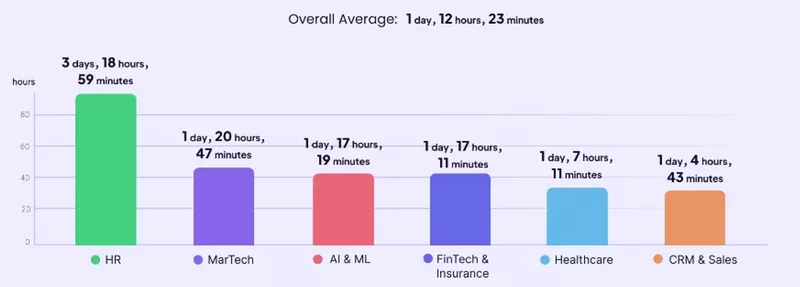
Keep in mind that developers need to see value fast in 2026. Userpilot finds that, if you can’t give users value within the first one to three days, you’ll likely see drop-off before activation.
A great example of this comes from Wes Bush, the Founder of ProductLed and a former growth marketer at Vidyard. He shared a refreshingly transparent article detailing a 30-day free trial he launched at Vidyard back in 2016. Which, by all accounts, was a complete failure.
But when Bush and his team switched to a freemium model, the company saw more than 100,000 downloads in the first 12 months. The difference for their use case was in that initial engagement. The 30-day no-credit-card trial didn’t engage users enough before trying to monetize them. But the freemium model did.
We’ll talk more about retention and other success metrics later on.But for now, take this as a lesson that your value funnels should be fast. And if you don’t yet have the resources to handle this alone, learn more about how to set up a content marketing engine in the age of AI.
2. AI-Powered Onboarding
Nobody really likes onboarding new platforms, especially developers already crushed between deadlines and other tasks. Yes, a user-friendly or intuitive platform goes a long way toward adoption, but there will always be questions that require a response.
AI-powered onboarding will be the great equalizer for 2026, since it allows users to get started within minutes without needing to learn the ropes on their own. This goes well beyond generative AI as well. For developers, this could mean:
A great example of this is AI Journey Management software, TheyDo, which is a MarTech product designed for CX and UX designers.
TheyDo originally took a more self-service approach to onboarding with click tours, chatbots, and YouTube video tutorials. But their time-to-value was still incredibly high, and the activation curve remained unencouragingly flat.
The marketing team knew that onboarding manually wasn’t scalable. But their self-service approach was leading to more drop-off than activations.
So they took a different approach with an AI company called Pyne and built, in their words, a “User Onboarding AI Agent.”
This AI avatar read micro-lessons to new TheyDo users, and offered interactive prompts so they could choose to learn more or less.
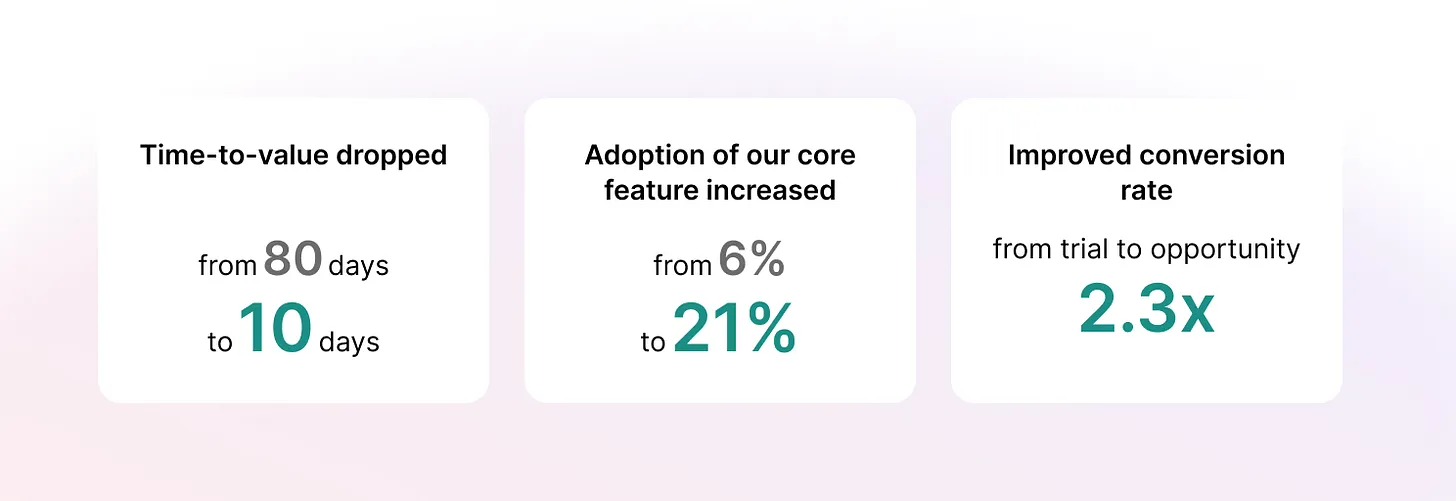
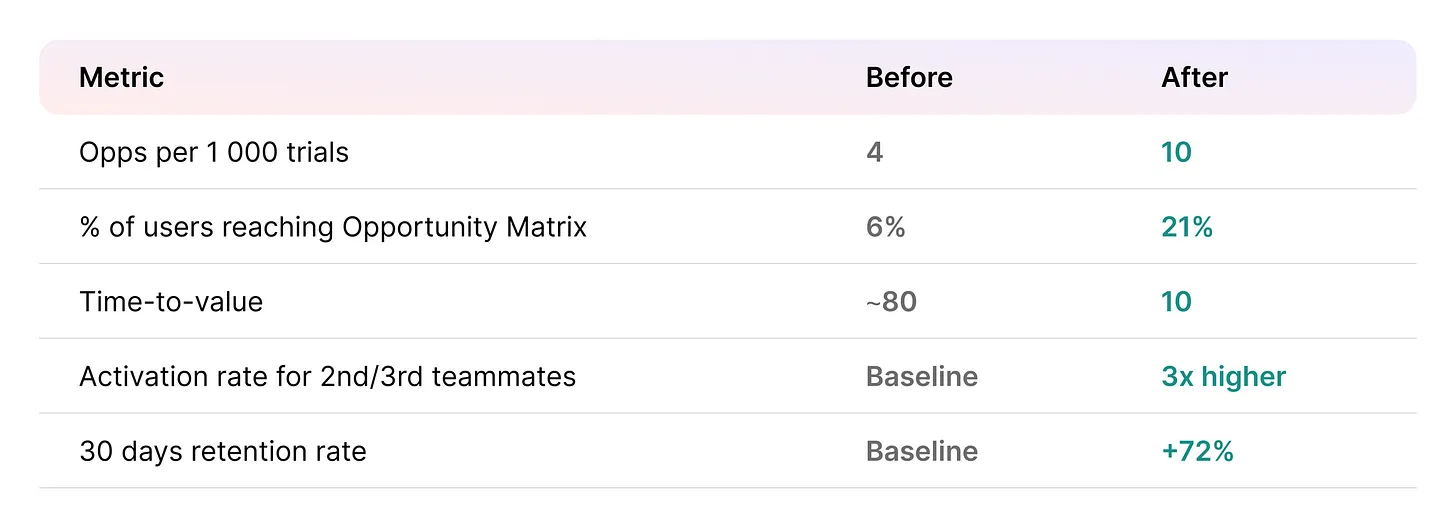
The results, frankly, speak for themselves:
3. Pricing for PLG Adoption
Cost isn’t everything in buying a new developer tool, but it certainly makes a difference in your perceived value (and your bottom line).
When we say ‘pricing for adoption,’ what we really mean is ‘pricing for growth.’ You want to create a pricing structure that appeals to the individual, scales to teams, and incentivizes users to grow with your SaaS over time.
That’s why the most successful platforms typically follow one of two structures:
If you use AI in any of your product offerings, usage-based pricing can be one of the most efficient models for recurring profit. In fact, OpenView Partners found that PLGs with usage-based pricing models had 38% faster revenue growth than businesses with strict subscription models. Look at Snowflake, for example, which has fast become a Wall Street darling.
Next, you should think about the structure of your free trial, since there’s a 75% chance you’re using one in the first stage of your PLG journey.
You can structure this trial in all sorts of ways, as this helpful table describes below:
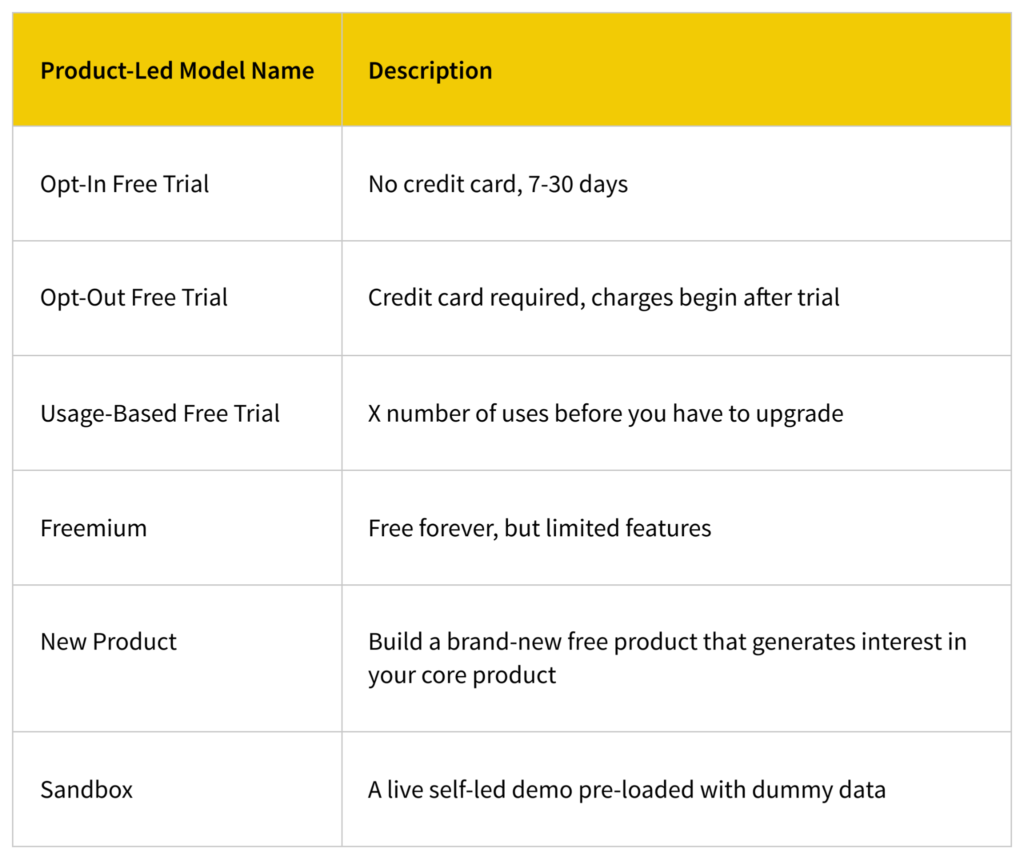
But the biggest differentiator between these models is what happens when the trial period ends.
In our experience, trials without required credit card information typically result in a 18% to 25% conversion rate. You get more leads up front, but they’re less likely to be qualified. They’re likely testing your software alongside other platforms, or are solving a one-off use case more than a long-term one.
Trials with credit cards required have a substantially higher conversion rate: 49% to 60% on average. The downside here is trial sign-up volume. This may drop off up to 70%, depending on the price of your dev product.
The question boils down to whether you want volume or qualification in your leads. It’s possible to enjoy the benefits of both, but more likely than not, you’ll need to pick one over the other in the beginning.
Just keep in mind you want this to be transparent. Make it easy for users to see exactly what they’re getting when they sign up, and what they should do next to get and keep their favorite features.
4. Measuring Success
This is a fairly dense point of conversation, but still imperative to building an effective, well-oiled PLG machine.
You can’t manage what you can’t measure, and when serving a developer audience, you need to know exactly what users are thinking so you can make adjustments that serve them well.
To do this, it’s best to zero-in on just a few KPIs:
Activation Velocity
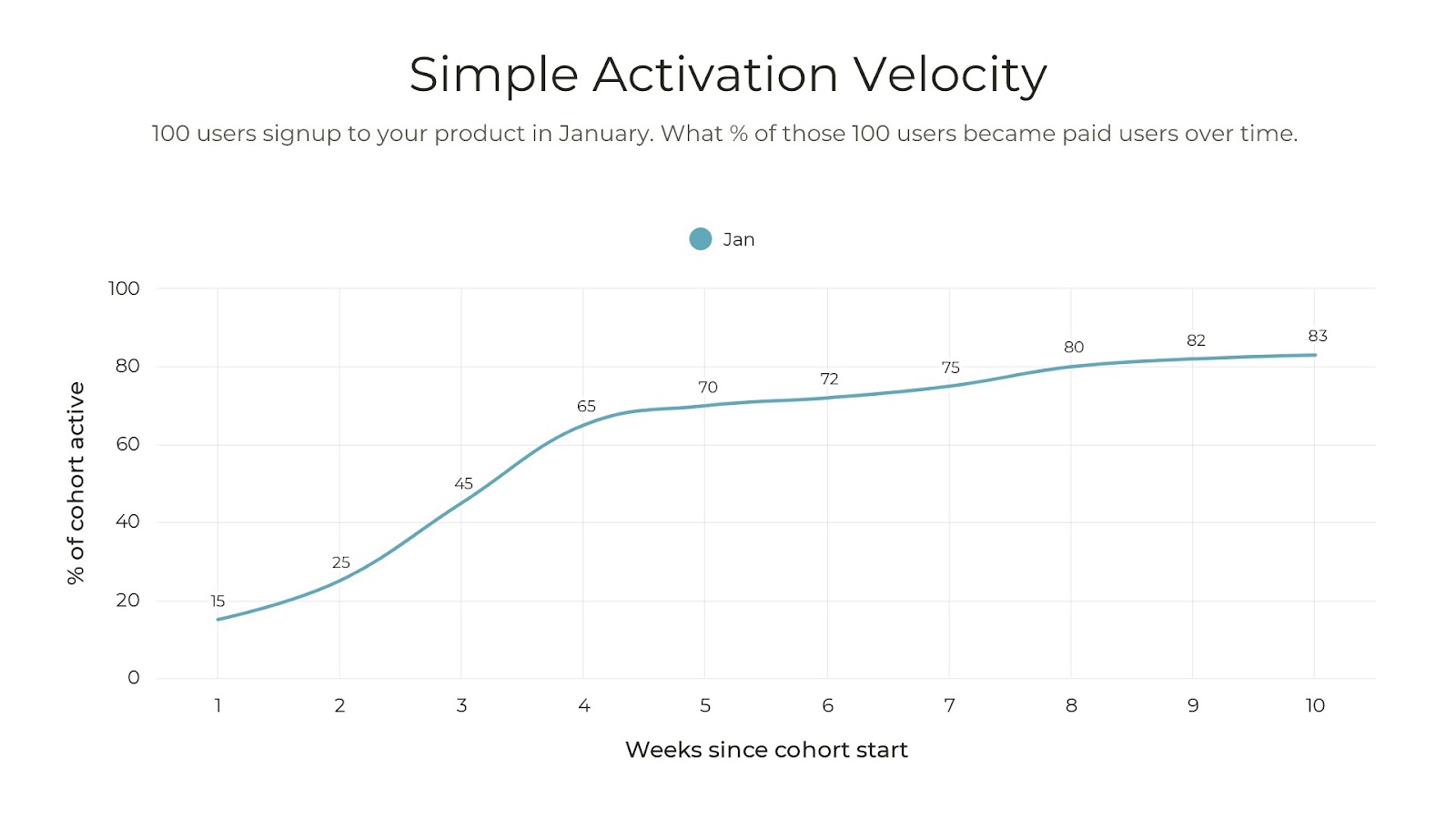
Activation velocity is a bit of a buzzword that, when translated from Jargonese, refers to what percentage of a cohort meets specific activation milestones. For example, this could be becoming a paid user or adding a new team member.
What ‘activation’ means depends heavily on your use case. Since you’re selling a dev tool, this might be the number of users logging in daily for a full week.
You should notice a ‘velocity curve’ that rises steeply in the beginning, then plateaus or levels out over the course of several weeks.
Like this:
A few rules of thumb to keep in mind for dev tools:
Expansion Signals
Any metric that proves your business is growing technically qualifies as an expansion signal.
For most developer tools, this should include:
There are several more metrics floating around here, but this is a solid place to start when scaling a product.
But I realize that retention deserves a somewhat deeper look.
We’ll talk more about retention a little later in the guide.
Community Metrics
I’m not saying every dev tool needs a full-blown community, but if you look at the statistics, it’s a pretty good sign you’re growing appropriately.
RevGenius reports that 55% of PLG SaaS companies have dedicated brand communities, and 58% of the best companies already have one, with some even hiring for roles despite the tech downturn.
If you’re not already on the bandwagon, now’s the time to get involved. If you already have a little community, continue to monitor and ‘plant seeds’ accordingly.
There’s not a benchmark per se for PLG communities, since every product and platform will look slightly different. But you should certainly be looking for signs of growth that ties back to your revenue.
Before you know it, you’ll have a community-led growth strategy underpinning your PLG.
Retention
Retention is the #1 pain of any developer tool, and for good reason. Paid acquisition arbitrage is practically gone in 2026, and with the rise of AI SaaS, the developer market has never been more competitive.
Take AI code generator tools, for example. There are dozens of clones in different coats of paint, and it’s not very expensive to switch from one platform to the other. This makes it easy for users to test three, four, or even five tools at once. These devs will ultimately abandon the tools they don’t find much value in.
A few suggestions for solving a low retention score:
For example:
There’s a spot of silver lining here: retention problems are often activation problems. You can’t retain people who were never truly invested in your product, after all.
So rather than looking at your retention metrics in isolation, pay closer attention to your onboarding success rates.
You can get more details and suggestions in the onboarding section above.
Most, if not all, of today’s fastest-growing SaaS tools heavily lean on product-led growth. But the strength of this strategy lies in its execution.
That means testing and iterating, and adjusting things that don’t work, and being empathetic to your user base, always.
Sure, the playing field looks different these days, but that’s also where your differentiator lies. Leaning into the AI zeitgeist without sacrificing the human touch will work wonders on reaching your lucrative, if very discerning, developer audience.
Q: What is a value-first funnel?
A value-first funnel simply provides value to the user first, before asking for commitment, setup, or payment. Instead of gating value behind forms or onboarding steps, users get something of value up-front (like a free trial or limited access to a tool) before moving into deeper levels of commitment.Many initiatives don’t make sense to be A/B tested, but still benefit from an experimental planning process.
Q: How does AI change PLG onboarding?
You can use AI to upgrade PLG onboarding with automated guidance for brand-new users, which means you don’t have to rely on customer success staff or dedicated account managers. It can also help new users generate setup steps, config files, or sample data based on user intent.
Q: What's usage-based pricing for devtools?
Usage-based pricing for devtools charge users based on the amount they use your product (think API calls, AI generation, compute time, and events). This model pairs naturally with PLG strategies, since users can start small and scale as their needs change.
Q: How fast should time-to-value be?
Developers should reach a time-to-value point within five to 15 minutes. Anything longer than that could dramatically increase drop-off.
Q: What metrics matter for PLG in 2026?
The fastest-growing PLG companies focus on metrics like:
Meagan is a professional writer in VA who specializes in content marketing, research, and SEO. If she's not helping the team at Draft.dev craft stories, she's helping others or working on some of her own. When she takes time to step away from the laptop, she enjoys hiking, farmer's markets, and occasional thru-hikes.